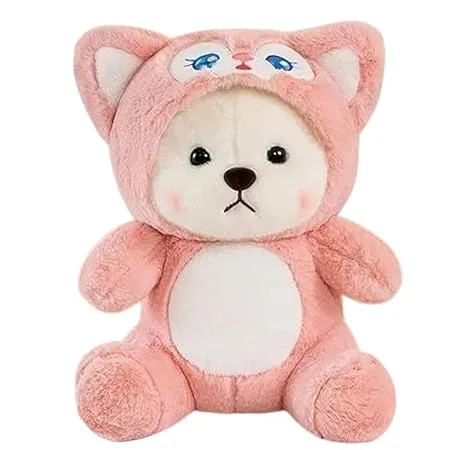
Quick answer: For small kids and everyday gifts, a 25–35 cm teddy bear is the most practical size: big enough to hug, small enough to carry and wash. Choose 10–20 cm for return gifts, keychains and bags; 40–60 cm for a “big hug” birthday or Valentine’s gift; and 90 cm and above only when you want a wow moment and have space at home. Always check whether the size is measured sitting or standing.
Teddy bears are sold in centimetres, but it is hard to imagine how big 35 cm really is when you are shopping online. Buy too small and the gift feels disappointing; buy too big and it sits in a corner taking up space. This guide translates sizes into everyday objects, recommends sizes by age and occasion, and lists the practical things — weight, washing, shipping — that people forget to consider.
Teddy bear size chart
| Size | Height | Roughly as big as | Best for |
|---|---|---|---|
| Mini | 10–15 cm | Your palm | Keychains, return gifts, car dashboards |
| Small | 20–25 cm | A school notebook | Toddlers, travel, budget gifts |
| Medium | 30–40 cm | The width of a pillow | Birthday gifts, bedtime hugs |
| Large | 50–80 cm | A 2–3 year old child sitting | Valentine’s Day, anniversaries, teens |
| Giant | 90 cm and above | An adult’s waist height or more | Grand surprises, shop display |
Note: Some sellers measure a bear sitting, others standing, and some include the ears. A 35 cm “standing” bear looks much smaller than a 35 cm “sitting” bear. Always check how the size is measured before you buy.
How to picture the size at home
- Take a measuring tape and hold it up next to your bed or sofa.
- Compare with a cushion: most sofa cushions are about 40–45 cm wide.
- For online orders, look for a photo of the toy held in a hand or next to a child.
- For gifts, think about where the toy will live — on a bed, a shelf, a desk or a car dashboard.
Best size by age
| Age | Recommended size | Why |
|---|---|---|
| 0–2 years | 20–30 cm, light | Easy to hold; embroidered eyes, no loose parts |
| 3–5 years | 25–40 cm | Big enough to hug, small enough to carry everywhere |
| 6–12 years | Any size | Design matters more — characters and trends win |
| Teens and adults | Large or giant, or keychains | Room decor, Valentine’s and birthday gifts |
For babies under 12 months, keep soft toys out of the cot during sleep and use them only during supervised awake time. More in our age-wise soft toy guide.
Best size by occasion
- Return gifts: 10–20 cm — see return gift ideas.
- Birthday gift for a child: 30–40 cm, like our 32 cm hoodie teddy.
- Baby shower or newborn: 20–30 cm with an embroidered face, like the sleepy-eyes bunny.
- Valentine’s / Teddy Day: medium bears with hearts, like the teddy with heart and wings, or a large bear. See Teddy Day gift ideas.
- Couples and anniversaries: a couple plush like the 50 cm mouse couple.
- Car or desk: 10–20 cm minis or keychains.
- Shop display: one or two giant bears near the entrance.
Size vs practicality
| Size | Easy to wash? | Easy to ship? | Space needed |
|---|---|---|---|
| Mini / small | Yes, by hand | Very easy | Shelf or bag |
| Medium | Yes, by hand or gentle machine if label allows | Easy | Bed or chair |
| Large | Harder; spot-clean often | Bulky carton | Corner of a room |
| Giant | Spot-clean only, usually | Expensive to courier | Dedicated space |
Learn more in our guide on how to wash soft toys at home.
Other things to check
- Weight: bigger bears get heavy — consider who will carry it, especially for young children.
- Washability: small and medium bears are easier to keep clean.
- Space: giant bears need a corner of the room and collect dust if not covered.
- Transport: large bears may need to be carried in a car rather than on a two-wheeler.
- Allergies: for children with dust allergies, smaller toys that can be washed often are better.
Size for different kinds of soft toys
“Size” feels different depending on the shape of the toy. A long-bodied animal or a doll looks bigger than a round teddy of the same height:
- Dolls: a 45–50 cm doll like the fairy doll or pink doll is tall but slim and easy for a child to hold.
- Animals with long ears: rabbits look taller because of their ears — check the body size too.
- Lying-down animals: realistic cats and puppies, like the sleeping puppy, are measured by length, not height.
- Keychains: usually measured including the ring or chain.
Common sizing mistakes
- Assuming the size includes only the body when it includes ears or a hat.
- Buying a giant bear for a toddler who cannot carry it.
- Choosing a tiny toy for a teen, who may prefer a large room-decor bear.
- Forgetting to check courier charges for large sizes.
Size advice for shops
Small and medium sizes sell fastest because they suit the most occasions and budgets. Giant bears are great for display and Valentine’s week but take up space and tie up money. A sensible approach is to stock mostly 15–40 cm toys, a few large bears and only one or two giant bears. See what to stock in a toy shop for a full starter mix.
Frequently asked questions
What is the most popular teddy bear size?
For everyday gifting, 30–40 cm bears are the most practical — big enough to feel special and easy to carry and wash.
Is a bigger teddy a better gift?
Not always. A medium teddy that a child can carry everywhere is often loved more than a giant bear that stays in a corner.
What size teddy for a 1-year-old?
Around 20–30 cm, light, with an embroidered face and no small parts.
What size teddy for Valentine’s Day?
Medium bears with hearts are the most popular; large bears suit a big surprise.
Which size should a shop stock most?
Small and medium sizes sell fastest; keep only a few giant bears for display.
Browse soft toys and teddy bears or buy in bulk.